Paid Surveys UK 2026 - 12 Tested Sites That Actually Pay





The 4 best paid survey sites in October 2026
Based on our test, these are the four sites we would join first in the UK right now.
Some bonuses are only credited after your first completed task and count towards the payout threshold rather than being paid out separately.
Not every survey site in the UK pays out. We registered on these sites with our own UK accounts and stayed with each one until money had left it.
-
1Sign up for free - genuine survey sites never charge a fee, and some add a sign-up bonus.
-
2Answer surveys - in the app or the browser, whenever you like: most take 5 to 20 minutes and pay up to £3.
-
3Cash out - from £1 in gift cards or £5 via PayPal, depending on the site.
Our tip: Join several sites. Each one only sends a limited number of surveys per month - with more accounts you get far more invitations.
This article contains affiliate links. If you sign up through one of them we may earn a commission - the price stays the same for you, and it never influences our assessment.
Best paid survey sites UK 2026 - tested and ranked
Testerup is run by aestimium GmbH in Hamburg and connects UK users with companies that want real feedback on mobile games, apps and digital products. It is not a classic survey panel: instead of collecting points at an unclear exchange rate, you see the cash amount for each task up front and it is credited in pounds. The platform lists product reviews and shorter surveys alongside the games - in the app, surveys sit as their own cards between the game offers - so it fits next to a pure panel like Mingle.
The ordinary steps of a ladder pay pence to about two pounds; the money sits in the ones Testerup calls burning rewards, and the biggest single step we reached credited £15.00. Sign-up takes about two minutes, needs no prior experience and carries a £10 bonus, but a ladder is days of play rather than minutes - each one runs on a deadline of three to ten days, and a step you reach late pays nothing. Payouts go out via PayPal from £55 in fixed amounts, and an approved request is given as up to three working days. On Trustpilot the platform sits at 4.1 out of 5 from 24,086 reviews, with 4.2 ★ on Google Play (145,000+ reviews).
Worth knowing: the £55 threshold is one of the higher ones on this page - our own UK account earned 33p an hour of free play across three weeks, and the £55 came together only once the tester put his own money into the games. Some reviewers also report the target moving while they were working towards it. If you want a first payout this week, start with Swagbucks, where PayPal and gift cards go out from £5, and treat Testerup as the higher-ceiling option you build up in parallel.
What that first hour on the account looks like, and what the platform does with a reward once it has been credited, is in our test notes:
One UK account on a phone, three weeks in August, and whatever the offer wall put in front of it. Two things about the way this platform is built matter more here than on any other page we write: almost everything else in this list is a survey panel, and Testerup works the other way round. A new account is shown exactly three games, with a counter underneath promising the rest in under two hours. After it runs out the wall settles at four to six offers at a time. The version of the platform you see in your first minute is the smallest one it has. So sign up, let the counter run down and look again in the evening. Judging the offer list straight after registering is the one avoidable mistake here, and it costs nothing to avoid it. A step here is measured in days, and the money sits on the step rather than on the time. The window attached to a ladder runs from three days at the short end to ten at the long one, and reaching a step on day nine pays exactly what reaching it on day two pays. Reaching it on day eleven pays nothing. That is the opposite of a questionnaire, where the payment follows the minutes, and it decides which offers are worth starting: ones whose next step you can finish inside its own window. What is credited is yours immediately. Testerup holds nothing back once a step has paid - there is no clearing period on rewards, so a step that lands on a Sunday counts towards a payout you request on the Monday. Check the wallet on the day a step falls: from that moment it is money you can take out. Surveys are in the app, and they pay pence. In the browser the wall held mobile game ladders for three weeks. Once our tester installed the app, surveys appeared as their own cards between the games, each showing its reward up front: 11p to 18p in our test, for around 20 minutes each. The money on Testerup sits in the game steps - if questionnaires are what brought you to this page, run a panel from further down it alongside. £55 is the highest entry price in this list. And it is not a threshold you cross with whatever your balance happens to be: you pick one of six fixed sizes, the smallest being £55, and the remainder stays behind for the next round. There is no way in from a computer. Every browser our tester tried came back with an error page while his phone worked normally on the same connection, so there is no way to have a look around from a desk before you commit to it.
What the account looks like in the first hour
Teststar names paid surveys as one of its own three ways to earn, next to testing mobile games and apps. In our own test account, though, the money sat in the game tasks: it showed game offers only, no surveys. Every offer shows its reward before you start, so you never put in time without knowing what it pays. On the day we signed up, the first three tasks were worth £554 together, the biggest up to £264 for one game task - the amount builds up level by level as you reach the stages the offer names. That makes it a natural partner for Testerup above - the same kind of quests, but you can start one in the browser before installing anything.
Sign-up is free and carries a £10 bonus. Payouts start at £55 in fixed amounts, and whatever is left over stays in your wallet with no expiry date. Choose the Visa virtual card or an Amazon gift card and you keep the full amount; PayPal deducts 5%. A payout request is usually processed within 48 hours.
Mingle has been running since 2005 and is operated by Bilendi Limited, registered in England and Wales and based in London. Across Europe the panel has more than 300,000 members. You get invitations by email, text or push notification, normally about one a week, and each project takes between 5 and 20 minutes. If you are screened out you still receive 2 mingle points, so the time is not entirely wasted.
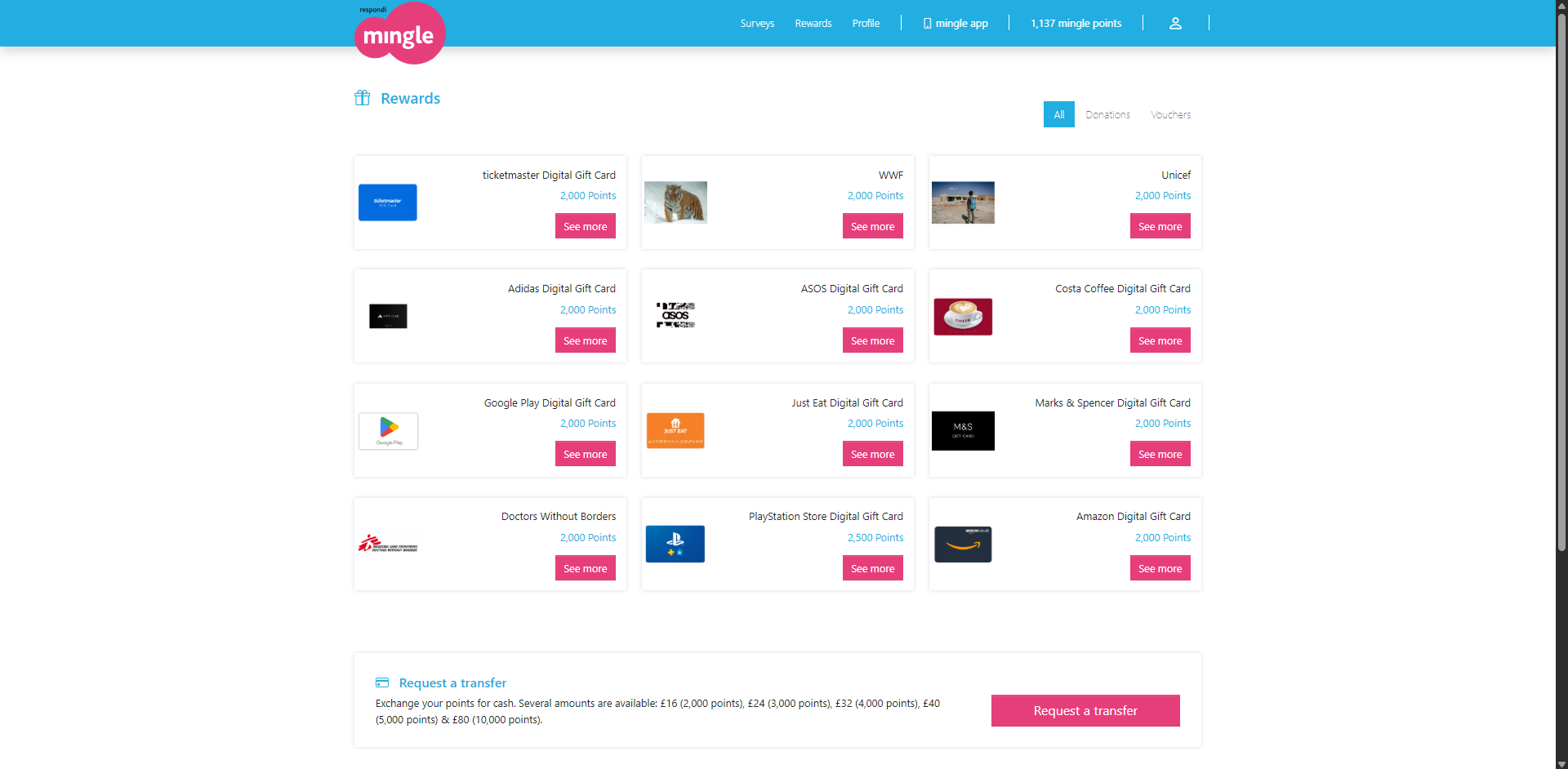
Rewards are collected as mingle points and redeemed for a bank transfer, a gift voucher or a donation to charity, with cash-out available from £16 (2,000 points). The voucher list is properly useful for the UK: Amazon, Marks & Spencer, Costa, Just Eat, Google Play, PlayStation Store, Ticketmaster and Adidas. Beyond standard questionnaires you get mobile surveys, closed online communities and now and then a product test you carry out at home - which is what makes Mingle a sensible second panel next to a task platform like Testerup. Registration is free from age 16, and one account per person is the rule.
Worth knowing: Mingle is a steady earner, not a fast one - roughly one invitation a week means it is best run alongside other panels rather than on its own. Points expire after 12 months without activity, so log in occasionally even in quiet periods.
How the invitations behave over a longer run, and what the points history in your account does and does not show, is in our test notes:
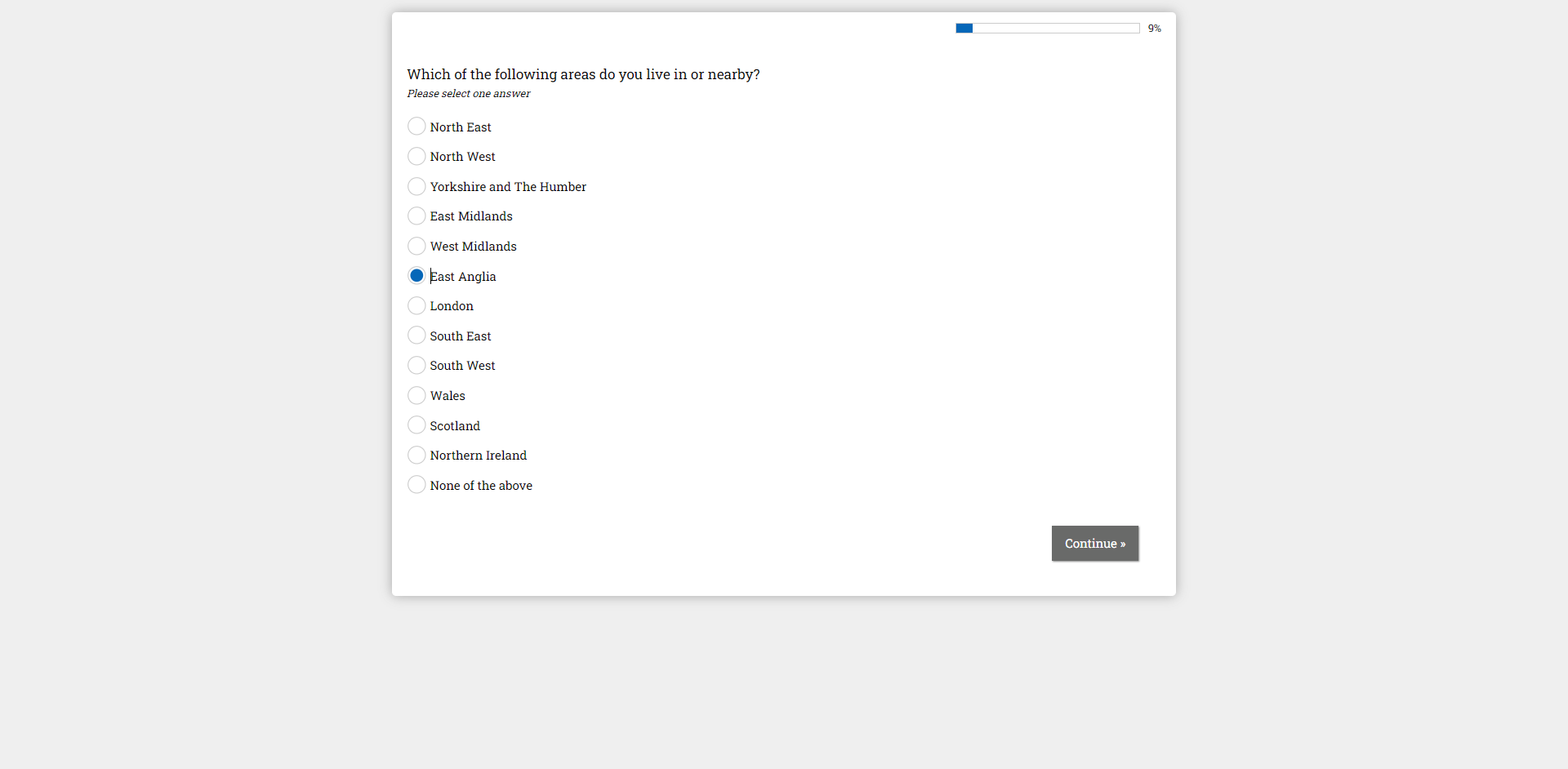
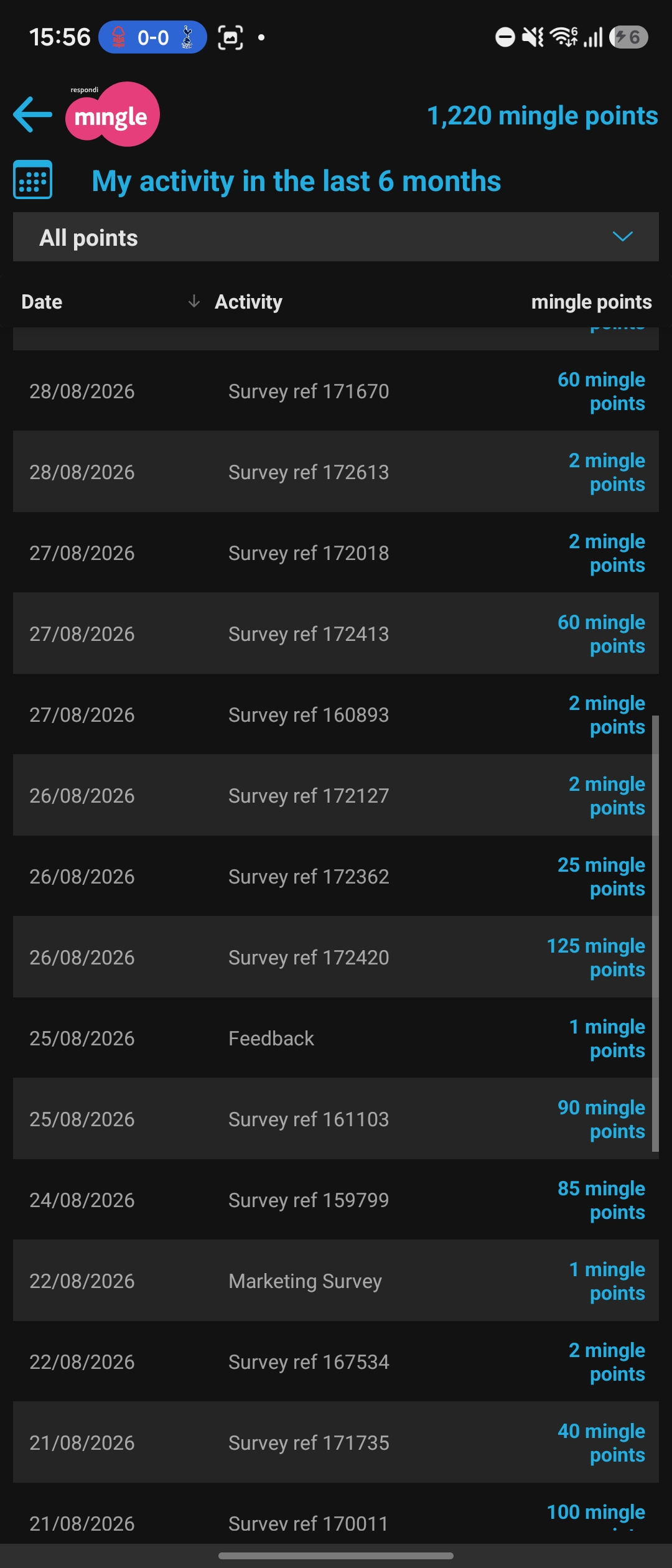
One UK account and 43 invitations across 19 days. Three things were noted for every one of them: the length the tile promised, the length it ran in practice, and what it credited afterwards. The same weeks were then read back off the panel's own points history, which is where the last section below comes from. Over those 19 days the invitations arriving each day roughly halved. The ones that paid did not move. Completed, credited surveys held at about one a day from the first week to the last, and the points landing per day ended the run roughly where they began. What thinned out were the invitations that stop after two minutes in the screening questions. It is worth saying plainly, because the opposite is the standard suspicion about any panel: that the tap gets turned down as you approach the reward. On an account in another market that went all the way over the line, the two busiest days of the whole run were the last two before it. Keep answering at the pace you started at, and the threshold arrives when the early weeks said it would. The 50 points for signing up are in that balance from day one, before a single questionnaire - 40p of the £16 you need, sitting there on the first afternoon. A survey you have just finished is not. One completed at 14:41 was still missing from the header at 15:13, and two evening surveys were only booked the following day. So a total you read tonight belongs to yesterday: count what you have answered rather than what the header says, and look again in the morning. The qualifying questions come first, at about nine per cent of the progress bar. One of them, from inside a live study: which of these areas do you live in or near. If the project is looking for somebody else, that is where it stops - a minute or two in, rather than after twenty. It happens to more than half of the invitations, and that is the honest figure for this panel and for most of the others on this page. Two things make it bearable here: it is over at the start rather than at the end, and a screened-out survey usually still credits two points. Open what you are sent, answer the first questions quickly and honestly, and the ones that carry on are the ones worth the evening. The points history is a payment record, not an activity record. Three invitations ended with no credit at all, not even the two consolation points - and not one of the three appears in the account's own history. Not as a zero: they are simply not in the list. About one abandoned survey in five leaves no trace there, so keep your own note if you want to know what a panel is costing you in evenings. There is only one tap. Points come from invitations and from nothing else - no offers, no games, no way to convert a free afternoon into more of them. That is why people run this panel next to two or three others rather than on its own, and it is what the list on this page is for.
What the panel shows you, and what it leaves out
Cashback.co.uk pays a £10 welcome bonus through the link on this page - twice what you get signing up directly. Behind the site is Tau Marketing Services in London, and it has put more than £3.2 million into members' accounts so far. That record shows in the ratings: 4.3 on Trustpilot across 2,300 reviews, plus a Highly Commended at the Moneyfacts awards.
You do not wait for invitations here - you work through ten levels, and one approved task opens the next. Every level puts a dozen or more in front of you, so nothing pushes you onto a task you do not fancy: free product samples, a trial week of Apple TV or Crunchyroll, app and game tasks, competition entries and short surveys. Most pay £2 to £5, some go up to £8.50, and the whole ladder is an evening's work. Once the ten levels are confirmed, the £10 bonus lands on top of everything you collected on the way up.
Clear the ladder in one sitting rather than in pieces. Each level is signed off by the advertiser before it counts, and that can take up to a couple of weeks - so ten tasks in one evening means ten confirmations running side by side instead of one after another. After that first cash-out the ladder is behind you for good: from then on every £10 you earn comes out on its own, and payments go out three times a week to PayPal or your bank account.
Two habits decide how much of it you keep. The samples are free, the postage is not - a case of beer or a box of laundry tablets costs £2 to £10 to ship, so take the tasks where the reward clearly beats the postage. And the streaming weeks pay in full as soon as they track, so put a reminder in your phone for day six and cancel before the subscription starts. Do those two things and every pound the ladder pays is a pound you keep.
At PrimeOpinion the average member earns a first reward 17 minutes after signing up, and you can cash out on the same day. You never wait for invitations here: you choose from hundreds of surveys in a list, and there is no daily limit on how many you take. A single survey pays you up to £4, and before you start one you see how long it takes and what you get for it. You take the surveys in the PrimeOpinion app or in your browser, and next to them you will find games you can earn with too.
You can cash out from £1, and the money reaches you within a few hours. Every survey you complete adds points to your balance, which you send to Revolut, a virtual Visa card or a Google Play voucher from £1, or take as PayPal cash from £5. You choose from more than 160 rewards in all, with Amazon, adidas and Decathlon vouchers among them. Your withdrawal is processed straight away, and you can cash out several times a day.
Joining is free, and your welcome bonus of up to £1 is in your account the moment you sign up. All you need is your email address, or you sign up with your Google, Facebook or Apple account. You pick the bonus yourself: the bigger one comes with a small minimum withdrawal, the regular one lets you cash out after just a few surveys. PrimeOpinion is run by Prime Opinion AB in Stockholm, part of the Swedish company Prime Insights. While the panels that invite you are still matching you to their studies, PrimeOpinion already has surveys you can take today.
Swagbucks is one of the most well-known rewards platforms globally, having paid out over $650 million to members. What sets Swagbucks apart is the sheer variety of ways to earn: beyond surveys, you can earn through cashback shopping, watching videos, web searches, daily polls and playing games.
For UK users, Swagbucks is particularly attractive because of its low £5 payout threshold - meaning you can cash out very quickly. The £10 sign-up bonus makes it easy to reach your first payout within an hour. Points (called SB) can be redeemed for PayPal cash or gift cards for Amazon, Tesco, M&S and many more UK retailers. The app is excellent and makes it easy to do surveys during your commute or lunch break.
Custard is not a survey panel but a UK rewards site: you pick paid tasks instead of waiting for invitations. Quick app installs and game tasks pay £1 to £5 each and take a few minutes, and surveys, free trials and shopping cashback sit alongside them. New members get £1 the moment they register.
The low threshold is the point. From £10, RapidPay sends your balance to PayPal within 48 hours; Amazon vouchers and bank transfer are the other options. Custard has been running in the UK since 2008 and is open to UK residents aged 18 and over.
YouGov is a London-based international research institute with 27 million members across 55 markets. What sets YouGov apart from other survey sites is the type of questions: instead of consumer products, topics cover current news, politics, media, social issues and brand perception. Many participants find these questionnaires genuinely engaging.
You earn points for each completed survey. Once you reach 5,000 points, you can withdraw £50 - either by bank transfer or as a gift card for Amazon, John Lewis or other UK retailers. The downside is the relatively high payout threshold - at 50p per survey, it can take several months. However, the surveys are short, the topics are interesting and the app makes it easy to participate on the go.
Origin Panel pays a whole household for watching TV and going online as it always does. Kantar runs it in partnership with ISBA, the Incorporated Society of British Advertisers, to measure how UK homes use TV and the internet. A Kantar technician installs a TV meter, a browser add-on and a small router box on a free home visit; after that there is nothing to answer and nothing to click.
Typical households collect £10 to £20 a month in vouchers, redeemable from £10 at Amazon, Argos, Sainsbury's, Nike or adidas, and every member is entered into monthly and quarterly prize draws worth up to £1,000. Places go by invitation, because Kantar keeps a representative sample of UK households: apply once, and if your household fits, it earns alongside any survey panel on this page.
LifePoints is the survey panel of Lightspeed, part of the Kantar Group - one of the big names in market research, with over 5 million members. You collect points for every survey you complete, and a single survey pays up to £5, depending on length and topic.
Rewards start small, so the first one comes quickly. An Amazon gift card is available from £5; PayPal and vouchers for M&S, Sainsbury's, Primark and other UK brands are on offer too, or you can donate to charities such as Cancer Research UK from £1. You can answer in the browser or in the app for iOS and Android.
Toluna is one of the larger survey communities - over 21 million members in 50 countries share their opinion on the products and services of well-known brands. A single survey pays up to 50,000 points, depending on its length, and you get 500 points as soon as you sign up.
Your points turn into PayPal cash or vouchers. In the rewards section you choose between a PayPal payment and vouchers from shops such as Amazon. Besides surveys, Toluna runs product tests, polls and games that earn points too, and you can take part in the browser or in the app for iOS and Android.
Opinion Outpost has become one of the go-to survey sites in the UK thanks to its remarkably low payout threshold of just £2.50. You only need to complete about 5 surveys to reach your first cashout, which keeps motivation high.
Surveys typically take 10-15 minutes and cover topics from consumer products to current affairs. Every survey you complete also enters you into a quarterly prize draw for £10,000. Payouts are available via PayPal or Amazon gift cards and are processed quickly. The app makes it easy to participate on the go.
How much can you realistically earn with paid surveys in the UK?
Let's be honest: you won't replace a full-time salary with surveys. But you can earn meaningful extra money. Here is what you can realistically expect based on how much time you invest:
Casual (30 min/day)
Regular (1 hr/day)
Dedicated (2+ hrs/day)
Effective rate (varies)
The effective hourly rate across UK survey sites ranges from about £3 to £12, depending on the platform. Prolific tends to pay particularly well (£6-£12/hr), while lower-tier sites may work out at £2-£3/hr. The key is being selective - don't waste 20 minutes on a survey that pays 30p. Focus on the top sites on this list and your hourly rate will be significantly better.
Key facts at a glance
Companies want to know what consumers think about their products and services. That's why they pay market research agencies, which in turn pay survey participants. Here is what you need to know about earning money with paid surveys in the UK:
- Survey sites pay you for your opinions and your data
- Your earning potential depends on the type of survey, your time and how many surveys you complete - some paid online surveys pay considerably more than others
- The more survey sites you join, the higher your earning potential; you can always pick the top-paying surveys and increase your effective hourly rate
- Legitimate providers never charge sign-up fees - genuine paid surveys in the UK are always free
- Trustworthy sites include Testerup, Mingle, Swagbucks, LifePoints, YouGov and others on this list
- Some providers send you free products to test - you keep them and receive payment on top
9 tips to maximise your survey earnings in the UK
Instead of just giving you a list of survey sites, we want to help you actually earn as much as possible. Here are tips to get the most out of every platform.
-
1Sign up for all recommended sites. If you want surveys for money as a serious side hustle, join as many sites as possible. That way, you always have surveys available and can pick the top-paying ones. There are no downsides - you can unsubscribe at any time.
-
2Use a separate email address. We recommend creating a dedicated email just for survey sites. This keeps things organised. Important: check your email daily - many invitations are only valid for 24 hours, sometimes less.
-
3Be honest. Answer surveys truthfully and avoid providing false information. Many sites use quality-check questions and inconsistent answers can get your account flagged or banned.
-
4Only join trustworthy sites. There are websites offering unreliable surveys - avoid these completely. They are typically recognisable by unrealistic promises. All sites on this page have been tested and verified by us.
-
5Cash out as soon as you hit the minimum. Always withdraw your earnings immediately once you reach the minimum threshold - unless you are saving for a larger reward. With some sites, points expire after a certain period.
-
6Complete your profile thoroughly. The more information you provide in your profile, the more survey invitations you will receive. Location, hobbies, education, pets and household size can all be relevant for matching you with surveys.
-
7Never pay to sign up. Legitimate sites always have free registration. All sites listed in this article are 100% free. Never pay a fee - regardless of what is promised.
-
8Check regularly for new surveys. Check at least every two to three days whether new surveys are available. Most surveys are only online for a few days - after that, participation is no longer possible.
-
9Use additional earning options. You can often earn extra money by signing up for free newsletters, downloading the survey app, referring friends or sharing on social media. Sites like Swagbucks offer many such bonus opportunities.
All sites mentioned on this page have been tested and verified by us. If you have tried one or more sites, please let us know about your experience.
How paid online surveys work in the UK
Market research only works with good data. That is why companies pay UK and international survey panels to find out what consumers think. This data is used to develop new products or improve existing ones. If you are wondering how to make money online in the UK, paid opinion surveys are one of the simplest options to get started. As a general rule: the more specific a survey and the smaller the target group, the higher the reward you can expect.
To answer surveys, all you need is an internet connection. Online surveys can be completed on your phone, tablet, laptop or PC - anywhere in the UK. Registration is always straightforward and all you need is a valid email address. By registering, you make no commitments and are completely free to decide whether and in which paid surveys you participate.
Survey sites to avoid in the UK
Unfortunately, not every survey site is worth your time. After testing 70+ platforms, here are the warning signs of a bad survey site:
• Charges a fee to join - Legitimate survey sites are always 100% free. If they ask for payment, walk away immediately.
• Promises unrealistic earnings - "Earn £500/day from surveys" is not realistic. Period.
• Has extremely high payout thresholds - If you need £100+ before you can cash out, you may never reach it.
• Has no clear payout methods - Reputable sites offer PayPal, bank transfer or major gift cards. Vague "rewards" are a red flag.
• Has poor Trustpilot reviews - Always check reviews. If the majority of ratings are 1-star with complaints about non-payment, steer clear.
• Asks for bank details or National Insurance number - Never provide this information to a survey site.
Do you need to pay tax on survey income in the UK?
The UK has a Trading Allowance of £1,000 per tax year. This means if your total earnings from surveys (and any other side income such as freelancing) stay below £1,000, you do not need to report it to HMRC and you do not owe any tax.
If you earn more than £1,000 from online income in a tax year, you will need to register as self-employed with HMRC and file a Self Assessment tax return. Survey income above the Trading Allowance is taxed at your marginal rate.
For most casual survey takers earning £50-£200/month, this will not be an issue. But if you are combining survey income with other side hustles and approaching the £1,000 mark, it is worth keeping records. For specific questions, we recommend checking with HMRC or a tax adviser.
Frequently asked questions about paid surveys in the UK
Yes - there are many trustworthy survey providers in the UK that pay real money via PayPal or bank transfer. You can certainly earn extra income with paid online surveys.
Earnings vary per platform and per survey - from a few pence to several pounds. A survey takes on average 10 minutes. The number of invitations per provider is limited, so the more sites you join, the higher your total extra income.
All survey sites mentioned by us are trustworthy and genuinely pay out. All survey providers must comply with UK GDPR (the Data Protection Act 2018) to protect your personal data.
All survey companies must comply with UK GDPR. This means your data cannot be shared with third parties without your consent. The company that commissioned the survey only sees your answers in anonymous form.
On average, you can expect about 10 minutes per survey. The range is typically 5 to 20 minutes per survey.
You earn the most by signing up for as many trustworthy sites as possible. Each site only invites you to a limited number of surveys per month. We recommend joining all trustworthy sites listed on this page.
All survey sites have a payout threshold - a minimum amount you must reach before you can withdraw. The threshold is typically between £1 and £20. Once the threshold is reached, payouts are usually processed within a few days.
After registering with a complete and honest profile at the survey sites of your choice, you can start. You receive invitations to participate in surveys. You accept these invitations and answer the questions honestly. It does not matter whether you do this on a smartphone, tablet or computer.
Once a minimum balance of a few pounds is reached, the reward is paid out as a bank transfer, PayPal payment or gift card. The minimum threshold is usually the equivalent of 1-2 surveys and the method of payment varies by provider.
Participation with trustworthy providers is always free. This applies to all aspects - from registration to survey allocation to submitting your completed questionnaires.
The minimum age for participation varies by provider. It is often 16, sometimes as young as 13. This means paid surveys are accessible to almost all age groups in the UK.
The UK has a Trading Allowance of £1,000 per tax year. If your total side income stays below this threshold, you do not need to report it to HMRC. If your total online income exceeds £1,000, you must register as self-employed and file a Self Assessment tax return. For specific questions, we recommend checking with HMRC or a tax adviser.
How we tested these survey sites
Who tested this for us



Every figure in the notes boxes above was read off a screen in a live account. We register from the UK the way a reader would, answer the invitations that arrive, take the tasks that are offered, and stay with the account until money has left it - the amount promised on the tile before we start, the request form, the receipt afterwards. Nothing here is lifted from a provider's own marketing page, and nothing is carried over from our older articles: where a figure had gone stale, it was measured again rather than copied.
The accounts belong to people we pay for the work. Each of them registers in the country they live in, on the phone or laptop they already own, and stays inside the rules the platform sets for everybody: one registration per person, no VPN, no emulator, and no help from a second account. Five markets and eighteen testers work under exactly those conditions. Nobody is handed a route through the sign-up questions either, because nobody hands you one.
What decides the order of the twelve. A site we have had our own account on is placed ahead of a site we know only from what it publishes - that is the first rule and it outranks every other. After it come the things a survey account lives on: how often invitations actually turn up, what a completed questionnaire pays against the time it really takes rather than the time it advertises, how far away the first payout is and in what form it comes, and what the platform does at the moment you ask to be paid. Reputation scores count, and they count last: they measure how people feel about a site, not what it credited.
Two things we will not turn into a number. How many invitations you personally will get: that follows the profile a panel builds out of your own answers, so a figure from our accounts would describe our testers rather than you. And any named study or game offer as a list to work through - catalogues here are rebuilt weekly, so anything named above is there to show how a mechanism works, and by the time you read it the title will have changed. What we do print is what one finished questionnaire pays and what the first payout asks for, because those two hold still.
Where the testing has got to. Two of the twelve entries carry a notes box, and those are the ones we have run accounts on ourselves, with the screenshots each figure was read from. The rest of the list is set out from the conditions each provider publishes and from what members report about being paid, with the date of the last check printed in every fact box. We work down the page in the order readers use it, which is why the top of the list is the best documented part of it.
We are paid when somebody signs up through this page. The provider links on this page are affiliate links; sign up through one and the provider pays European Funding Guide a commission. That money bought nobody a position: the platform sitting at the top of the list is also the one whose cash-out screen gets the roughest treatment in the notes above, and the panel in second place is the one we say plainly you should not run on its own.
* This article contains affiliate links. If you click an affiliate link, European Funding Guide may receive a commission from the provider. The price or offer does not change for you.

Dr. Mira Maier is Editor-in-Chief of European Funding Guide and has been writing about scholarships and study financing since 2012.