Paid Surveys UK 2026 - 12 Tested Sites That Actually Pay





► Table of contents
There are more and more market research companies paying for your opinion. But not all survey sites in the UK are equally reliable. That's why we've put together a curated list of trustworthy paid survey sites in the UK. We show you how much you can realistically earn with each provider - transparently, without exaggeration.
Earning money with paid online surveys in the UK is easier than you might think: you decide when and which surveys you take. Almost all providers have a survey app, so you can take surveys on the go. When you have a few minutes of spare time - on the train, during lunch or on the sofa - you can quickly complete a survey for money. The average survey takes about 10 minutes. Unlike a regular part-time job, there are no fixed hours, no commute and no schedule. Paid surveys are therefore one of the most accessible forms of working from home in the UK - ideal if you want to earn money from home without investment or qualifications. You choose when, how much and which surveys you complete. Whether you are looking for surveys for money as a side hustle, want to get paid for surveys in your free time, or simply want to find online surveys that pay - this guide covers it all. Whether you call them online surveys for money in the UK, top paid surveys or simply the best survey sites, the principles are the same.
This article contains affiliate links. If you sign up through one of them we may earn a commission - the price stays the same for you, and it never influences our assessment.
All 12 sites at a glance
This quick-scan table compares all survey sites that pay UK residents. Use it to find the right sites for you before reading the detailed reviews below. Click any site name to jump straight to its review.
Paid online surveys are suitable for almost anyone in the UK looking for flexible extra income. Here is who benefits most:
- Students - ideal pocket money between lectures; most sites accept members from age 13 or 16. A popular way to make money as a student without fixed hours.
- Stay-at-home parents - complete surveys during nap time or school runs. No childcare needed, no commute. Many of the top survey apps let you earn from home with just your phone.
- Part-time workers and retirees - top up your income in your spare time with paid questionnaires at your own pace.
- Anyone looking for quick money - unlike most side hustles, you can get paid for surveys without any upfront investment, experience or special skills.
Best paid survey sites UK 2026 - tested and ranked
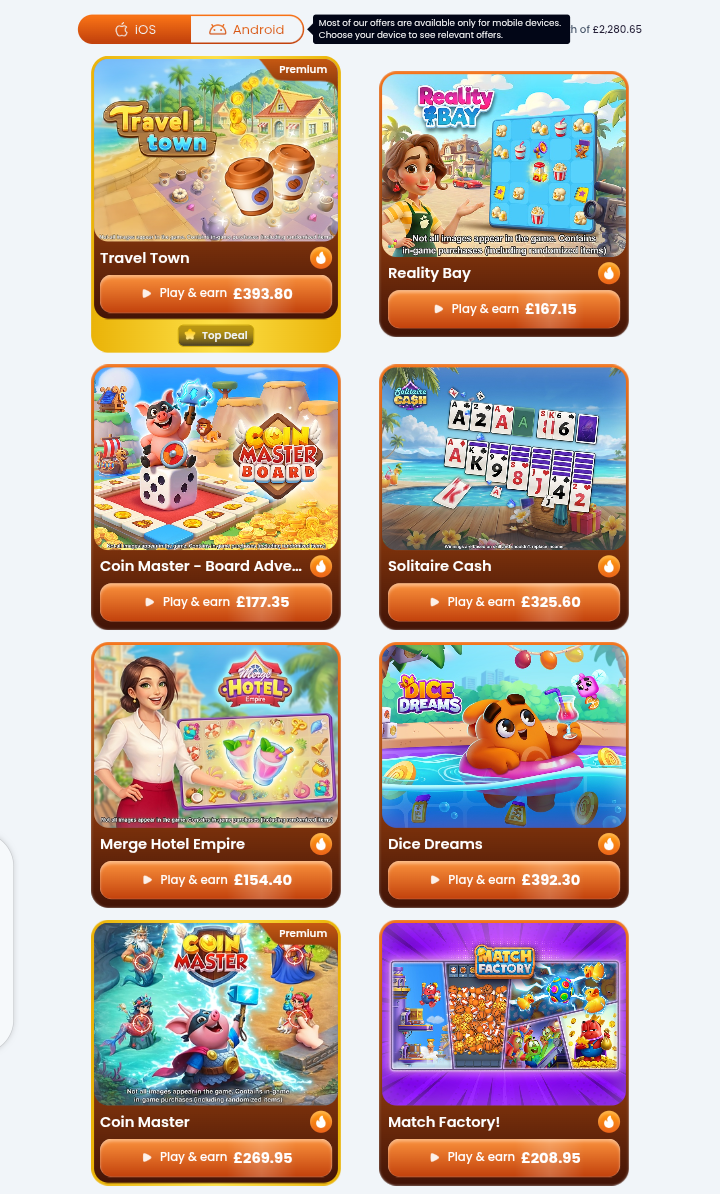
Testerup pays for more than surveys. Next to paid survey tasks it carries mobile games you play up to a level it sets, and more than two thousand smaller jobs - which makes it worth an account for the days when the panels above have nothing that fits you. You are paid in pounds rather than points, and every task shows its amount on the tile before you start. Testerup is run by aestimium GmbH in Hamburg and has more than three million users worldwide. Signing up is free and open from 18, there is a £10 sign-up bonus on the registration screen, and three offers are ready straight away - the rest of the list unlocks about two hours later.
What you work through is a ladder of game levels with a clock on it. In three weeks of testing, the offer wall held games throughout. The small steps pay up to about £2 each. The money sits further up, in the steps Testerup calls burning rewards - the biggest single one in our test credited £17.80. Reaching one of those is hours of play rather than minutes, and the deadline is what decides: rarely longer than ten days, and a step you reach too late pays nothing at all.
Start an offer in the session you find it in. The list rotates through the day, so a seven-day deadline is worth nothing to you if the offer has gone by the time you want to begin. Take the ladder whose deadline you can genuinely meet, and open it before you put the phone down.
A package inside the game buys you speed, not money. What our tester spent came back to him, and the dependable effect was the pace rather than the profit. So buy when a deadline is close and you would otherwise miss the step you are playing for, and take the cheapest package the game sells.
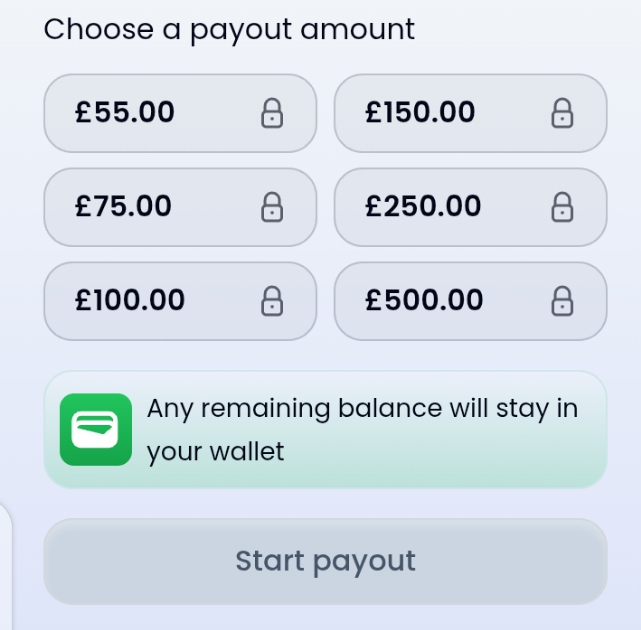
Testerup does not release your balance, it releases fixed amounts. The smallest of the six is £55, and whatever sits above the sum you pick stays in your wallet - the platform states it does not expire, so it counts towards the next one. PayPal is the route it names, and a request that has been approved is given as up to three working days.
Two things to know before you start rather than at the end. The first payout needs a one-off face verification, so budget for that step rather than being surprised by it. Against that, nothing is parked on the way: a step that has been credited counts towards the threshold immediately, and there is no holding period to sit out before it can leave.
Three weeks on the platform, five game ladders followed step by step and every purchase logged to the penny. What the tiles promise, what the steps actually pay and where the money sits in a ladder is in our test notes:
One account in the UK, 30 hours across three weeks in August, five game ladders followed from the first step, every in-game purchase written down to the penny. The screenshots below come from that account. Testerup advertises three ways to earn: paid survey tasks, mobile games and a couple of thousand smaller jobs. What reached our tester over three weeks was the middle one. The offer wall held mobile games throughout - no physical products to try and keep, and the name notwithstanding, no app or product testing among them. So if you come here for the games, the wall is what you get; if you come for the surveys, plan on a second panel next to it. On day one the dashboard offered three games described as "Worth of £1,127.80". After ten hours of play and one purchase the account stood at £26.10 - 2.3 per cent of that figure. The advertised number adds up every step to the end of the ladder, including the ones with deadlines almost nobody meets. It is the size of the game, not a forecast. Two offers from the same three weeks went in opposite directions, and the reason is not luck. One paid £17.80 for reaching board 18 after six hours of play and £7.97 spent. The other paid 20p for four and a half hours and £4.99 spent - because everything below level 23 in that offer added up to £1.40 and the remaining £25.50 hung on a single final step the deadline did not allow. So before you start, look at where the money sits on the ladder. An offer that puts almost everything on the last step is a bet on the deadline, not on your progress - and if you miss it, the hours are gone as well as the stake. The same holds inside one game: on one board our tester earned £17.80, and eight boards later the step was worth 30p. One chain we followed from the first room to the last answers this best. Rooms 1 to 4 paid 10p, 20p, 20p and 30p. Room 5 was the first of the bigger steps at £1.50, and the game's first purchase returned 70p as cashback - £3.00 in total against £2.99 spent and three hours of play. It carried itself to the penny and paid nothing for the time. The day after, our tester carried on without spending anything, and the difference was the point: with the package he had cleared five rooms in three hours, and without it room 6 took a day and was half done. A purchase here does not buy the reward, which would have arrived anyway. It buys the deadline. Five reached steps worth £7.20 together sat unbooked for several days, then arrived on their own - no support ticket, nobody doing anything. What pointed the wrong way in the meantime was the offer page itself: it named "reach 27" while our tester was on level 28, and "reach level 12" while he was on 16. The display lags the booking by days. So do not replay a level because the page tells you to, and give a missing credit a couple of days before you write to anyone. Testerup does not pay out a balance, it pays out fixed sums, and the page shows them before you ever get there: The free route is slow, and we can put a number on it. Across a cleanly measured week, everything that cost nothing - the daily rewards for playing and the small ladder steps - came to around 50p a day. Against a smallest payout sum of £55, that is the arithmetic to plan with. Testerup suits people who play anyway, not people who want to avoid spending on principle. You cannot plan a route. Six offers listed one evening had all disappeared by the next morning, and two were back that afternoon. A ladder with a seven-day deadline is only worth choosing if you can start it immediately. The name sets the wrong expectation. Anyone signing up for product tests gets a games list - and on this page in particular, anyone signing up for surveys gets one too. The deadline carries the money, not the playing. Whoever wants neither the clock nor the spending is left with the small steps, and those are the 50p a day.
Testerup in detail - what our test found
Mingle is more than a survey list. Alongside the online questionnaires there are mobile surveys, closed communities you get invited into, and now and then a product test you carry out at home and keep. That mix is what makes it a sensible second panel next to a task platform, rather than a replacement for one. Mingle is the UK panel of the market researcher Bilendi, has been running since 2005, has more than 300,000 members across Europe and holds 4.0 out of 5 stars from over 23,000 Trustpilot reviews.
The counting is in mingle points, and the sum is easy: 125 points are £1. The first 50 are yours for signing up. Most projects are advertised at 20 minutes or less and the longest of them pay up to a pound. You find them in the survey tab of your account, and Mingle also invites you by email, text and push - expect up to eighteen invitations in a week, and expect them in bursts rather than spread out.
A study you do not qualify for costs you seconds here, and it still pays. Mingle screens at the start rather than after twenty minutes, and credits two points for the attempt. Those two points belong to the screening: on the rare study that stops you later, there is nothing. Fill in your profile before your first survey - Mingle picks the studies by it, so the better it knows you, the less often you are the wrong audience.
The amount is fixed when the project is advertised, so every minute over the tile is unpaid - and there are usually some. An "up to" figure is a ceiling in the same way, not a forecast. And there is nothing here to grind: points come from invitations and from nothing else, so a free afternoon buys you none. Take Mingle alongside something else and pick the projects up as they arrive.
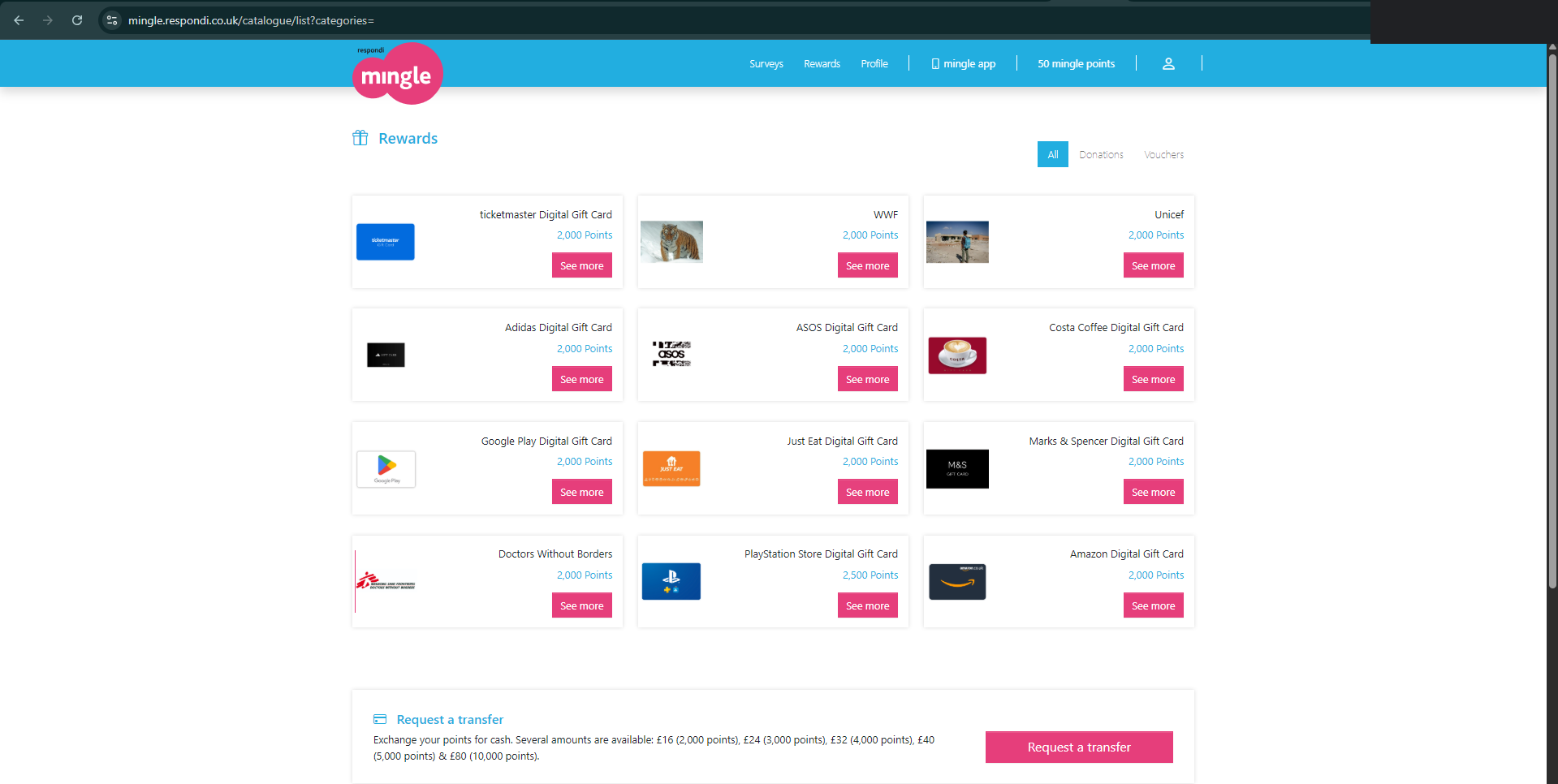
Two thousand points buy £16 in your bank account, and the only tile that costs more is the PlayStation Store voucher. Eleven of the twelve rewards sit at 2,000 points and so does the smallest bank transfer, so a voucher does not bring your first payout any closer than a transfer does. You choose freely: Marks and Spencer, Just Eat, Costa Coffee, Google Play or Amazon, a transfer in fixed steps up to £80, or a donation to WWF, Unicef or Doctors Without Borders - take whichever you would actually use.
Thirteen days, 31 surveys, each one logged with the time it was advertised at, the time it really took and the points it paid. What the tiles add up to, what actually arrived and how far away the first payout is:
One account in the UK, 31 surveys across 13 days, plus the full rewards catalogue read off the screen. Mingle counts in mingle points: 125 points are one pound. The price follows one rule: 5 points for every advertised minute. Of the 18 surveys in our log that carried a time, ten sat exactly on that and two came close. Five points a minute is £2.40 an hour, and that is the figure the tiles add up to when you read the list. It is not the figure that arrived. Over all 31 surveys, 810 points came in across 285 minutes actually spent inside a survey - £1.36 for every hour at the keyboard. Two things take the difference, and only one of them is about being screened out. Seven surveys ran all the way through and paid the full advertised amount. Six of the seven took longer than they said: Half as long again, in other words - and that is the good case, where nothing went wrong and the full amount was paid. Because the amount is set against the advertised minutes, the extra ones are unpaid: the £2.40 an hour on the tiles is already down to around £1.60 before anybody is screened out at all. 18 of 31 were over before the survey proper began, at two points each. The same panel produced the same rate in another country, so this is how it works rather than a run of bad luck. Three surveys paid nothing at all: one screen-out that came without the two points, one that would not open on a computer or a phone, and one stopped after eight minutes for "quality issues" with nothing said about what had been flagged. That last one is the expensive kind. Two projects paid less than they advertised. One was billed as "up to 100 points" and credited 10. Another promised 55 points plus a 20-point bonus and credited the 55. So check a credit against the tile afterwards when a bonus was part of the offer. The rate is identical on all five transfer steps - 125 points to the pound from the smallest payout to the largest. So there is no better tile to save up for, and choosing a voucher over a transfer does not bring the first payout closer either. How far away 2,000 points are: at the rate our test produced, somewhere between two and three weeks of taking part daily from a standing start. Nothing shortens it, because Mingle has one source of points and it is the invitation. It stays pocket money. The tiles add up to £2.40 an hour; what actually landed over 13 days was £1.36. More time does not change the rate, and there is no way to earn faster than the invitations arrive. The week is not plannable. The supply swung from eight invitations in a single day to two days with none. Anyone who needs a fixed weekly amount will not plan it here. There is no PayPal, and nothing at all below 2,000 points. Money into your account means a bank transfer and bank details; everything else in the catalogue starts at the same place.
Mingle in detail - what our test found
Advertised
Actually took
Points
11 min
20 min
55
20 min
30 min
100
10 min
15 min
40
17 min
11 min
85
18 min
32 min
90
25 min
42 min
125
5 min
8 min
25
106 min
158 min
520
YouGov is a London-based international research institute with 27 million members across 55 markets. What sets YouGov apart from other survey sites is the type of questions: instead of consumer products, topics cover current news, politics, media, social issues and brand perception. Many participants find these questionnaires genuinely engaging.
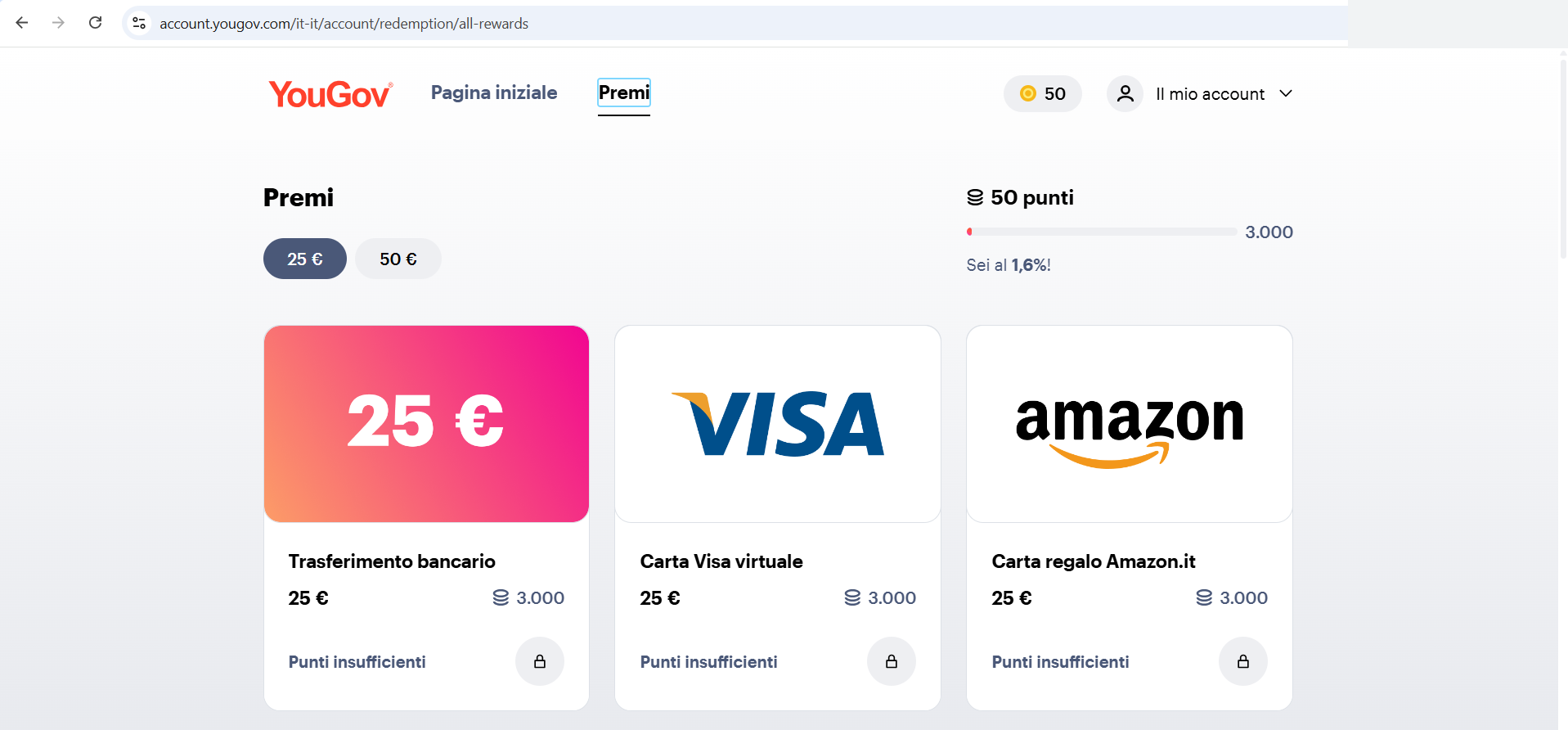
You earn points for each completed survey: 100 points are £1, a typical survey pays 50 and a good one up to 100. The threshold is 5,000 points, so £50 - the highest on this page, and nothing comes out below it. What does work in your favour is that no reward costs more points than another: there is no cheaper tile to save up for, so pick what you actually want. Take YouGov alongside a portal with a small threshold rather than instead of one - there you collect this week's money, here the fifty grows.
When you take it as cash, everything hangs on the name on the account. YouGov sends the money through Wise to your bank account, and the account holder has to match yours exactly - if it does not, the payout bounces, and that is the most common reason it fails. If a bank account is not what you want, the same £50 comes as a prepaid Visa card you can spend anywhere, or as a gift card from a UK retailer with Amazon at the front.
Three of our testers ran YouGov accounts of their own, from the sign-up through the survey list to the payout page. Here is what that turned up. You need 5,000 points before anything comes out, and that is £50. There is no smaller step underneath it, and nothing that speeds it up: points come from invitations and from nowhere else, so a free afternoon buys you none. At one to two surveys a week and around 50p each, that is a road of months. Which is exactly how to use YouGov - let it run in the background while a panel with a low threshold pays this week's money. Bank transfer, prepaid Visa card, gift card: every reward costs the same number of points. There is no cheaper tile to save up for and no penalty for cashing out the moment you qualify, so choose what you actually want rather than what looks like better value. That is not true of every panel on this page - on some, a voucher gets you out earlier than a transfer. Cash goes to your bank account through Wise, and the name on that account has to match yours exactly. That is the most common reason a payout bounces - more common than a mistyped sort code. Get it right first time and the money is with you in one to three working days. If you would rather not hand over bank details at all, the prepaid Visa card and the Amazon voucher reach the same £50. Reckon on about a third longer than the time advertised. The amount is fixed the moment a survey goes out, so those extra minutes are unpaid - worth knowing before you start a twenty-minute one late in the evening. The topics make up for a lot of it: politics, brands and current affairs rather than washing powder, and you see the results in the papers a week later. Before your first payout YouGov wants a photo of an ID document and a selfie, taken on your phone. In good daylight with a clean document it is a few minutes. It can also come back refused without telling you what was wrong, and then the only thing to do is take the pictures again - which is a nuisance on a Tuesday evening and a real problem on the day you want your £50. So get it out of the way in the first week, not at the finish line. The threshold is the highest on this page. £50 at one to two surveys a week is months, not weeks. As your only panel, YouGov does not work. There is no second lever. No games, no offers, nothing for signing up. Every point comes from an invitation, and the invitations come at their own pace. No PayPal. Cash means a bank account in your own name.
YouGov in detail - what our test found
Cashback.co.uk pays a £10 welcome bonus through the link on this page - twice what you get signing up directly. Behind the site is Tau Marketing Services in London, and it has put more than £3.2 million into members' accounts so far. That record shows in the ratings: 4.3 on Trustpilot across 2,300 reviews, plus a Highly Commended at the Moneyfacts awards.
You do not wait for invitations here - you work through ten levels, and one approved task opens the next. Every level puts a dozen or more in front of you, so nothing pushes you onto a task you do not fancy: free product samples, a trial week of Apple TV or Crunchyroll, app and game tasks, competition entries and short surveys. Most pay £2 to £5, some go up to £8.50, and the whole ladder is an evening's work. Once the ten levels are confirmed, the £10 bonus lands on top of everything you collected on the way up.
Clear the ladder in one sitting rather than in pieces. Each level is signed off by the advertiser before it counts, and that can take up to a couple of weeks - so ten tasks in one evening means ten confirmations running side by side instead of one after another. After that first cash-out the ladder is behind you for good: from then on every £10 you earn comes out on its own, and payments go out three times a week to PayPal or your bank account.
Two habits decide how much of it you keep. The samples are free, the postage is not - a case of beer or a box of laundry tablets costs £2 to £10 to ship, so take the tasks where the reward clearly beats the postage. And the streaming weeks pay in full as soon as they track, so put a reminder in your phone for day six and cancel before the subscription starts. Do those two things and every pound the ladder pays is a pound you keep.
Swagbucks is one of the most well-known rewards platforms globally, having paid out over $500 million to members. What sets Swagbucks apart is the sheer variety of ways to earn: beyond surveys, you can earn through cashback shopping, watching videos, web searches, daily polls and playing games.
For UK users, Swagbucks is particularly attractive because of its ultra-low £1 payout threshold - meaning you can cash out very quickly. The £10 sign-up bonus makes it easy to reach your first payout within an hour. Points (called SB) can be redeemed for PayPal cash or gift cards for Amazon, Tesco, M&S and many more UK retailers. The app is excellent and makes it easy to do surveys during your commute or lunch break.
With Ipsos i-Say you answer surveys for Ipsos, the international market research group, and earn £0.50 to £3 for each one. A survey takes you 5 to 20 minutes, and the rarer specialist studies pay up to £30. Stay active and you can be invited to focus groups paying up to £300 per session - one session like that can be worth more than months of short surveys.
A screen-out still earns you something. If a survey closes on you partway through, you keep a few points anyway - a detail many panels do not match. You can redeem from £5 for vouchers such as Amazon, M&S or John Lewis, and PayPal cash is in the catalogue too. Joining is free if you live in the UK and are 16 or older.
Screenwise pays you for using your devices the way you already do. It is a research panel run by Kantar, with Google as software partner, and it is aimed mainly at UK residents aged 18 to 34. Instead of answering questionnaires, you install an app on your phone, a browser extension and a TV meter, and the panel measures the videos you watch, your TV viewing and the pages you visit in the background.
The setup takes about 20 minutes and is the part that pays most. Once all three pieces are running, Screenwise credits £100 in points, and from then on points arrive every month. From 10,000 points (£10) you swap them for vouchers at Amazon, Argos, John Lewis, Tesco or Sainsbury's, or give them to charity. Adding more devices raises the monthly points, and you can leave whenever you like.
Origin Panel pays a whole household for watching TV and going online as it always does. Kantar runs it in partnership with ISBA, the Incorporated Society of British Advertisers, to measure how UK homes use TV and the internet. A Kantar technician installs a TV meter, a browser add-on and a small router box on a free home visit; after that there is nothing to answer and nothing to click.
Typical households collect £10 to £20 a month in vouchers, redeemable from £10 at Amazon, Argos, Sainsbury's, Nike or adidas, and every member is entered into monthly and quarterly prize draws worth up to £1,000. Places go by invitation, because Kantar keeps a representative sample of UK households: apply once, and if your household fits, it earns alongside any survey panel on this page.
Branded Surveys is a dedicated survey platform that focuses specifically on paid surveys - no videos, no games, just well-paying questionnaires. The UK is one of their key markets, which means there are always surveys available for British residents.
The badge system rewards loyal users: the more surveys you complete, the better opportunities you unlock. In our test, it took approximately 45 minutes to reach the first cashout at £3.80 - which is impressively fast. After that, typical earnings settle at around £3-£4 per hour. Daily polls provide easy bonus points. You can also earn ongoing points for referring friends. Payouts via PayPal are usually processed within 1-3 business days.
Qmee is a London-based platform with one standout feature: there is no minimum payout threshold whatsoever. You can cash out from your very first penny. This makes it ideal if you want to see your earnings instantly without waiting to accumulate a balance.
Beyond surveys, Qmee also rewards you for regular web searches through its browser extension and for cashback on online shopping. Surveys typically pay between 20p and £3. The app works well on both iOS and Android, making it easy to fit surveys around your schedule. If speed of payment is your priority, Qmee is hard to beat.
Opinion Outpost has become one of the go-to survey sites in the UK thanks to its remarkably low payout threshold of just £2.50. You only need to complete about 5 surveys to reach your first cashout, which keeps motivation high.
Surveys typically take 10-15 minutes and cover topics from consumer products to current affairs. Every survey you complete also enters you into a quarterly prize draw for £10,000. Payouts are available via PayPal or Amazon gift cards and are processed quickly. The app makes it easy to participate on the go.
Custard is not a survey panel but a UK rewards site: you pick paid tasks instead of waiting for invitations. Quick app installs and game tasks pay £1 to £5 each and take a few minutes, and surveys, free trials and shopping cashback sit alongside them. New members get £1 the moment they register.
The low threshold is the point. From £10, RapidPay sends your balance to PayPal within 48 hours; Amazon vouchers and bank transfer are the other options. Custard has been running in the UK since 2008 and is open to UK residents aged 18 and over.
How much can you realistically earn with paid surveys in the UK?
Let's be honest: you won't replace a full-time salary with surveys. But you can earn meaningful extra money. Here is what you can realistically expect based on how much time you invest:
Casual (30 min/day)
Regular (1 hr/day)
Dedicated (2+ hrs/day)
Effective rate (varies)
The effective hourly rate across UK survey sites ranges from about £3 to £12, depending on the platform. Prolific tends to pay particularly well (£6-£12/hr), while lower-tier sites may work out at £2-£3/hr. The key is being selective - don't waste 20 minutes on a survey that pays 30p. Focus on the top sites on this list and your hourly rate will be significantly better.
Key facts at a glance
Companies want to know what consumers think about their products and services. That's why they pay market research agencies, which in turn pay survey participants. Here is what you need to know about earning money with paid surveys in the UK:
- Survey sites pay you for your opinions and your data
- Your earning potential depends on the type of survey, your time and how many surveys you complete - some paid online surveys pay considerably more than others
- The more survey sites you join, the higher your earning potential; you can always pick the top-paying surveys and increase your effective hourly rate
- Legitimate providers never charge sign-up fees - genuine paid surveys in the UK are always free
- Trustworthy sites include Swagbucks, Branded Surveys, YouGov and others on this list
- Some providers send you free products to test - you keep them and receive payment on top
9 tips to maximise your survey earnings in the UK
Instead of just giving you a list of survey sites, we want to help you actually earn as much as possible. Here are tips to get the most out of every platform.
-
1Sign up for all recommended sites. If you want surveys for money as a serious side hustle, join as many sites as possible. That way, you always have surveys available and can pick the top-paying ones. There are no downsides - you can unsubscribe at any time.
-
2Use a separate email address. We recommend creating a dedicated email just for survey sites. This keeps things organised. Important: check your email daily - many invitations are only valid for 24 hours, sometimes less.
-
3Be honest. Answer surveys truthfully and avoid providing false information. Many sites use quality-check questions and inconsistent answers can get your account flagged or banned.
-
4Only join trustworthy sites. There are websites offering unreliable surveys - avoid these completely. They are typically recognisable by unrealistic promises. All sites on this page have been tested and verified by us.
-
5Cash out as soon as you hit the minimum. Always withdraw your earnings immediately once you reach the minimum threshold - unless you are saving for a larger reward. With some sites, points expire after a certain period.
-
6Complete your profile thoroughly. The more information you provide in your profile, the more survey invitations you will receive. Location, hobbies, education, pets and household size can all be relevant for matching you with surveys.
-
7Never pay to sign up. Legitimate sites always have free registration. All sites listed in this article are 100% free. Never pay a fee - regardless of what is promised.
-
8Check regularly for new surveys. Check at least every two to three days whether new surveys are available. Most surveys are only online for a few days - after that, participation is no longer possible.
-
9Use additional earning options. You can often earn extra money by signing up for free newsletters, downloading the survey app, referring friends or sharing on social media. Sites like Swagbucks offer many such bonus opportunities.
All sites mentioned on this page have been tested and verified by us. If you have tried one or more sites, please let us know about your experience.
How paid online surveys work in the UK
Market research only works with good data. That is why companies pay UK and international survey panels to find out what consumers think. This data is used to develop new products or improve existing ones. If you are wondering how to make money online in the UK, paid opinion surveys are one of the simplest options to get started. As a general rule: the more specific a survey and the smaller the target group, the higher the reward you can expect.
To answer surveys, all you need is an internet connection. Online surveys can be completed on your phone, tablet, laptop or PC - anywhere in the UK. Registration is always straightforward and all you need is a valid email address. By registering, you make no commitments and are completely free to decide whether and in which paid surveys you participate.
Survey sites to avoid in the UK
Unfortunately, not every survey site is worth your time. After testing 70+ platforms, here are the warning signs of a bad survey site:
• Charges a fee to join - Legitimate survey sites are always 100% free. If they ask for payment, walk away immediately.
• Promises unrealistic earnings - "Earn £500/day from surveys" is not realistic. Period.
• Has extremely high payout thresholds - If you need £100+ before you can cash out, you may never reach it.
• Has no clear payout methods - Reputable sites offer PayPal, bank transfer or major gift cards. Vague "rewards" are a red flag.
• Has poor Trustpilot reviews - Always check reviews. If the majority of ratings are 1-star with complaints about non-payment, steer clear.
• Asks for bank details or National Insurance number - Never provide this information to a survey site.
Do you need to pay tax on survey income in the UK?
The UK has a Trading Allowance of £1,000 per tax year. This means if your total earnings from surveys (and any other side income such as freelancing) stay below £1,000, you do not need to report it to HMRC and you do not owe any tax.
If you earn more than £1,000 from online income in a tax year, you will need to register as self-employed with HMRC and file a Self Assessment tax return. Survey income above the Trading Allowance is taxed at your marginal rate.
For most casual survey takers earning £50-£200/month, this will not be an issue. But if you are combining survey income with other side hustles and approaching the £1,000 mark, it is worth keeping records. For specific questions, we recommend checking with HMRC or a tax adviser.
Frequently asked questions about paid surveys in the UK
Yes - there are many trustworthy survey providers in the UK that pay real money via PayPal or bank transfer. You can certainly earn extra income with paid online surveys.
Earnings vary per platform and per survey - from a few pence to several pounds. A survey takes on average 10 minutes. The number of invitations per provider is limited, so the more sites you join, the higher your total extra income.
All survey sites mentioned by us are trustworthy and genuinely pay out. All survey providers must comply with UK GDPR (the Data Protection Act 2018) to protect your personal data.
All survey companies must comply with UK GDPR. This means your data cannot be shared with third parties without your consent. The company that commissioned the survey only sees your answers in anonymous form.
On average, you can expect about 10 minutes per survey. The range is typically 5 to 20 minutes per survey.
You earn the most by signing up for as many trustworthy sites as possible. Each site only invites you to a limited number of surveys per month. We recommend joining all trustworthy sites listed on this page.
All survey sites have a payout threshold - a minimum amount you must reach before you can withdraw. The threshold is typically between £1 and £20. With Qmee, there is no minimum at all. Once the threshold is reached, payouts are usually processed within a few days.
After registering with a complete and honest profile at the survey sites of your choice, you can start. You receive invitations to participate in surveys. You accept these invitations and answer the questions honestly. It does not matter whether you do this on a smartphone, tablet or computer.
Once a minimum balance of a few pounds is reached, the reward is paid out as a bank transfer, PayPal payment or gift card. The minimum threshold is usually the equivalent of 1-2 surveys and the method of payment varies by provider.
Participation with trustworthy providers is always free. This applies to all aspects - from registration to survey allocation to submitting your completed questionnaires.
The minimum age for participation varies by provider. It is often 16, sometimes as young as 13. This means paid surveys are accessible to almost all age groups in the UK.
The UK has a Trading Allowance of £1,000 per tax year. If your total side income stays below this threshold, you do not need to report it to HMRC. If your total online income exceeds £1,000, you must register as self-employed and file a Self Assessment tax return. For specific questions, we recommend checking with HMRC or a tax adviser.
How we tested
Who tested this for us




Every site on this page is judged the same way. We open a real account from the UK and do the work on it - surveys, offers, whatever the site pays for - and follow it through to the withdrawal: the request, the fee line, the money arriving. Where we quote an amount, it was read off the screen at the time: the task as it was presented, the payout form before the confirm button, the withdrawal history afterwards. We do not lift earnings figures from a provider's own marketing page.
The accounts are run by paid testers, each in their own country and on their own device, under the platform's own rules: one account per person, no VPN, no emulators, no bots, nobody helping out on a second account. A test that breaks the terms tells you nothing about what you would actually get.
The ranking weighs real payout data, what an hour of work is actually worth, how fast the money arrives, how much work is available in the UK, and Trustpilot reputation. Sites that failed to pay, screened testers out excessively or carry poor user reviews are not listed here at all.
Two things we deliberately do not publish. We do not quote an hourly rate for a site unless we have measured one cleanly - a figure that quietly includes a sign-up bonus or a tester's own spending flatters the platform and misleads you at the same time. And we do not promise that a specific offer is still there: offers and their deadlines rotate weekly on every site of this kind, so treat any named task as an example of how the site works, not as a shopping list.
Where we are with the full test. Running an account to a completed withdrawal takes weeks per site, so we work through the list in the order our readers use it. The sites we have already run an account on carry a test-notes box in their entry above, with the screenshots and the numbers behind them. The remaining sites are ranked on payout data, published terms and user reviews, and re-checked on the date shown in each data box.
We earn a commission if you sign up through the links on this page. It does not change what our testers measured, and it did not decide the ranking - our top pick's test notes spell out what speaks against it as plainly as any other box on this page.
* This article contains affiliate links. If you click an affiliate link, European Funding Guide may receive a commission from the provider. The price or offer does not change for you.

Dr. Mira Maier is Editor-in-Chief of European Funding Guide and has been writing about scholarships and study financing since 2012.